
Table of Contents
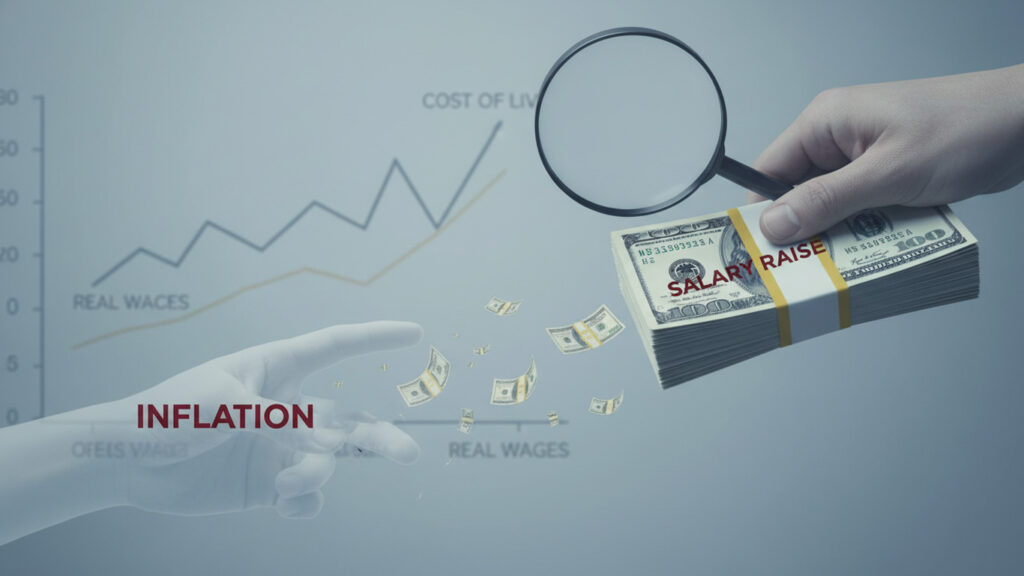
Receiving a salary raise is feeling like progress. Your payment is going up, your employer is acknowledging your value, and it is feeling like you are moving forward in the financial aspect. In the United States, even a small annual raise is often seen as a sign for stability and growth.
But here is the truth that is making uncomfortable: many salary raises are not actually making you more rich.
In fact, in a large number of cases, the inflation is quietly absorbing most or maybe all of that raise before you are feeling its benefit. The loss is subtle, it is gradual, and it is rarely discussed, which is why it is continuing year after year without any resistance.
This article is explaining how inflation silently erodes the salary increases, why this is happening even when the income rises, and how the mathematics exposes what your paycheck alone is not exposing.
Why a Raise Is Feeling Bigger Than It Is Truly
When you are hearing, “You are getting a 5 percent raise,” your brain is translating that into a progress. More income must be meaning more power to purchase things.
But the inflation is working in direction which is opposite.
Inflation is increasing the cost for everything you are buying:
- Housing
- Food
- Transportation
- Healthcare
- Insurance
- Utilities
If your salary is increasing at the same pace as inflation, your purchasing power is staying flat. If it is growing slower than inflation, you are effectively earning less money, even though the number on your paycheck is higher.
This disconnect only is why many people are feeling stuck financially despite regular raises.
Nominal Income Versus Real Income
To understand what is happening, you are needing to separate two concepts.
Nominal income is the number that is printed on your paycheck.
Real income is what that paycheck can buy actually after adjusting for the inflation.
Employers are announcing raises in nominal terms. Inflation is affecting real income.
If inflation is not being part of the conversation, the raise can be misleading only.
A Simple Example Using Real Numbers
Imagine one employee who is earning 60,000 dollars per year.
They are receiving a 4 percent raise, which is increasing their salary to 62,400 dollars.
At first look, that is looking like good progress.
Now you assume that inflation for the year is 5 percent.
That means cost of living increased faster than the salary increase.
In real terms, the purchasing power for 62,400 dollars is actually lower than 60,000 dollars was in the previous year.
The employee is earning more dollars but they can afford less.
This is not some theoretical scenario. It is happening frequently, especially during periods of high inflation.
Why Inflation Is Hard to Notice
Inflation is not arriving as one single bill or one warning.
It is showing up quietly:
- Groceries are costing a little more
- Rent is increasing slightly
- Insurance premiums are rising
- Subscriptions are adjusting pricing
Each increase is feeling manageable if you are taking it alone. Together, they are quietly cancelling out income growth.
Because inflation is spread across many expenses, people are rarely calculating its total impact. As long as the paycheck number is being higher, it is feeling like progress.
The mathematics is telling a different story.
The Compounding Effect of Inflation
Inflation is compounding just like the interest is compounding.
A 3 to 5 percent increase in prices every year is not simply adding up. It is stacking.
Over 10 years, moderate inflation can reduce purchasing power dramatically. Over 20 or 30 years, the difference is becoming life-changing.
This is why raises in early career are mattering so much. Inflation is affecting not just one year of income, but every future dollar that is tied to that baseline.
Why Salary Raises Are Lagging Behind Inflation
Many employers are structuring raises based on:
- Company performance
- Budget constraints
- Industry benchmarks
They are not tied directly to the inflation.
As a result:
- Raises are often fixed percentages
- Inflation is varying year to year
- Purchasing power is becoming unpredictable
During high-inflation periods, even the “good” raises may be failing to keep up.
Employees are feeling like they are moving forward while quietly standing still.
Inflation Is Hitting Fixed Expenses the Hardest
Not all expenses are inflating equally.
Some categories are tending to rise faster:
- Housing costs
- Healthcare expenses
- Education
- Insurance
These are also the least flexible parts for a budget.
When fixed expenses are rising faster than income, discretionary spending is shrinking. Saving is becoming harder, even with the higher salary.
This is why inflation is often feeling more painful than official averages are suggesting.
Why High Earners Are Not Immune
Higher income is not protecting against the inflation.
In some cases, it is amplifying the problem.
Higher earners often are:
- Upgrading housing
- Increasing lifestyle spending
- Carrying larger fixed obligations
When inflation is hitting, these larger expense bases are magnifying the impact.
A 5 percent increase in costs on a 100,000 dollar lifestyle is hurting more than same percentage on a 40,000 dollar lifestyle.
Inflation is scaling with spending, not with the income.
The Illusion of “Catching Up Later”
Many people are assuming they will outgrow the inflation later in their careers.
This assumption is being risky.
Inflation is compounding continuously, while income growth is uncertain. Career progression is slowing down over time. Raises are becoming smaller and also less frequent.
If purchasing power is lost early and is not recovered, the gap is compounding forward.
Delaying the problem is not eliminating it. It is magnifying it.
Why Inflation Is a Bigger Threat Than Taxes for Many People
Taxes are visible. Inflation is not visible.
You are seeing taxes deducted on every single paycheck. You are rarely seeing inflation deducted anywhere, yet it is affecting every purchase you are making.
Over a lifetime, inflation can cost more than taxes in lost purchasing power if income is not growing faster than the prices.
The difference is that taxes are feeling painful immediately. Inflation is feeling painless until it has already done the damage.
How Inflation Is Impacting Long-Term Goals
Inflation is not just affecting the monthly expenses.
It is affecting:
- Retirement savings targets
- Emergency fund adequacy
- College planning
- Home affordability
Goals that are set without adjusting for inflation are often ending up underfunded.
A retirement number that is feeling sufficient today may fall short decades later if inflation is being underestimated.
Why Raises Alone Are Not Being Enough
Relying only on the salary increases is a fragile strategy.
Raises are:
- Controlled by employers
- May not keep pace with inflation
- Slowing down later in careers
Inflation is operating independently of your effort or your performance.
This mismatch is why long-term financial stability is requiring thinking beyond the income.
The Real Measure of Progress
True progress is not how much your salary is increasing, but how much your purchasing power is growing.
If your income is rising faster than inflation, you are moving forward.
If it is rising slower, you are falling behind, even if it is feeling like progress.
This distinction is the difference between feeling financially stable and actually being financially resilient.
Final Thought
Inflation is not announcing itself. It is not asking for permission. It is not caring how hard you are working.
It is quietly rewriting the value of your income every single year.
Understanding this is not about the fear. It is about having clarity.
When you are measuring progress in real terms instead of nominal numbers, financial decisions are becoming grounded, realistic, and intentional.
That awareness only is what is protecting your future long before inflation is making its presence obvious.
Related Analysis
How to Build a Monthly Budget Using the 50/30/20 Rule (With Real Examples)
February 13, 2026
The Psychology of Small Expenses: Why Daily Spending Hurts More Than Big Purchases
February 11, 2026
Why Two People With the Same Salary End Up With Very Different Net Worths: A Math-First Breakdown
February 9, 2026
Compounding Is Not Magic: It’s Just Time Doing the Heavy Lifting
February 7, 2026