Table of Contents
Few financial debates in United States are as emotionally charged like rent versus buy matter. Homeownership is often framed as one milestone for success, stability, and proper adulthood. Renting, on other hand, is frequently portrayed as “throwing money away.”
But emotion clouds the judgment.
When you strip away lifestyle preferences, social pressure, and personal identity, rent versus buy thing becomes one numerical problem. And same like most numerical problems, the answer depends on variables, timelines, and opportunity cost, not any beliefs.
This article rebuilds the rent versus buy debate using only math, cash flows, and long-term outcomes only.
Why the Rent vs Buy Debate Is So Confusing
The confusion exists because people compare the wrong things.
They compare:
- Monthly rent vs monthly mortgage payment
- Pride of ownership vs flexibility
- Stability vs mobility
They rarely compare:
- Total cash outflow
- Opportunity cost of capital
- Inflation-adjusted returns
- Liquidity and risk
Once you shift the comparison to those factors, the debate becomes clearer.
The Two Questions That Actually Matter
The rent vs buy decision boils down to two core questions:
- Where does your money go over time?
- What does that money become after years of compounding?
If buying converts cash into an appreciating asset more efficiently than renting plus investing, buying wins.
If renting frees capital that compounds faster elsewhere, renting wins.
Everything else is noise.
The True Cost of Buying a Home in the U.S.
Buying a home is not just a mortgage payment.
The real cost includes:
- Down payment
- Closing costs
- Property taxes
- Homeowners insurance
- Maintenance and repairs
- Opportunity cost of tied-up capital
Most comparisons ignore at least half of these.
The Down Payment Factor
A down payment is not an expense. It is capital that gets locked.
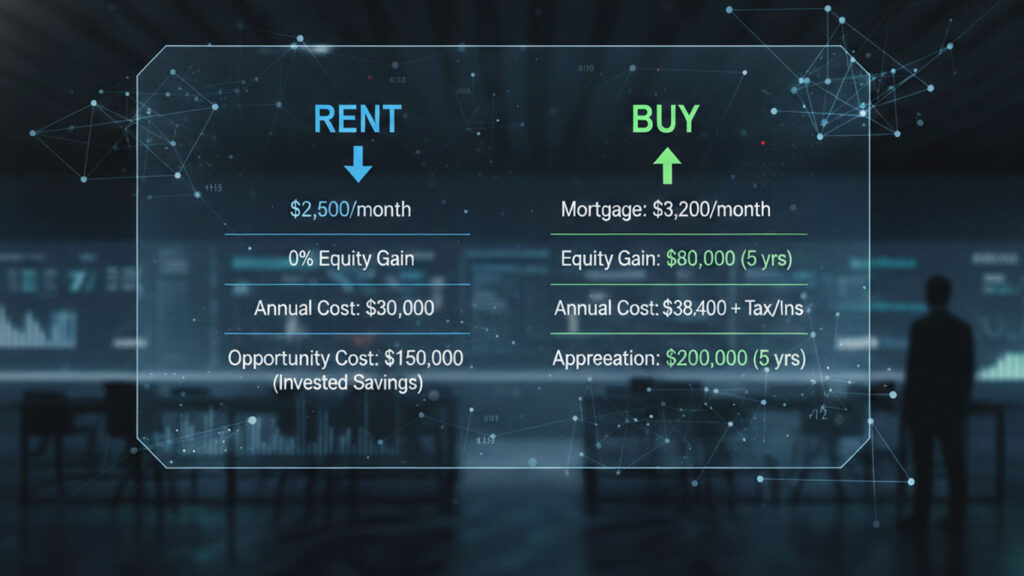
For example, a $400,000 home with a 20 percent down payment requires $80,000 upfront.
That $80,000 is no longer liquid. It cannot be invested elsewhere. Its return is now tied to home price appreciation.
This is where the math starts diverging.
Mortgage Payments Are Not the Same as Rent
A mortgage payment has two components:
- Principal
- Interest
Only principal builds equity. Interest is a cost, similar to rent.
In the early years of a typical U.S. mortgage:
- Most of the payment goes toward interest
- Equity builds slowly
- Loan balance declines at a crawl
For years, homeowners may feel like they are “owning,” while the bank still owns most of the property.
Property Taxes and Maintenance Are Permanent Costs
Unlike a mortgage, property taxes never end.
Even after the home is paid off:
- Property taxes continue
- Insurance continues
- Maintenance continues
Maintenance is often underestimated.
Generally, homeowners should expect to spend 1 to 2 percent of the home value per year for maintenance over the long term. Roofs, HVAC system, plumbing, and structural repairs are not optional expenses. They are just delayed expenses.
Renters do not pay these directly.
The Rent Side of the Equation
Renting is often dismissed as a pure expense. That is incomplete.
Renting converts housing into a predictable monthly cost while keeping capital liquid.
Renters avoid:
- Large upfront payments
- Maintenance surprises
- Property tax risk
- Market concentration risk
What matters is what happens to the money not spent on buying.
The Opportunity Cost Most People Ignore
This is the most important part of the analysis.
When you buy a home, you commit:
- Down payment
- Closing costs
- Ongoing maintenance capital
That money could have been invested.
If a renter invests the equivalent capital consistently, the long-term results can rival or exceed home equity growth, depending on market conditions and time horizon.
Renting only “loses” if the saved capital is wasted instead of invested.
Appreciation Is Not Guaranteed
Home prices in the U.S. have grown over long periods, but not evenly.
Appreciation depends on:
- Location
- Timing
- Interest rate environment
- Local economic health
A home is a leveraged asset, which magnifies both gains and stagnation.
If appreciation is modest and costs are high, the real return on home equity can be lower than expected.
Ownership does not automatically equal wealth creation.
Time Horizon Changes Everything
Rent vs buy outcomes depend heavily on how long you stay.
Short time horizon:
- Transaction costs dominate
- Buying becomes expensive
- Renting often wins
Long time horizon:
- Fixed-rate mortgage payments stabilize
- Inflation works in favor of ownership
- Buying becomes more efficient
There is no universal answer without a timeline.
A home is not a flexible asset. The longer you stay, the more the math improves.
Inflation Affects Renters and Owners Differently
Inflation increases rents over time, but it also erodes the real value of fixed mortgage payments.
For homeowners with fixed-rate mortgages:
- Monthly payments stay constant
- Real cost decreases over time
For renters:
- Rent adjusts upward
- Cash flow pressure increases
This is one of the strongest mathematical arguments for buying, but only if the initial purchase makes financial sense.
Liquidity and Risk Concentration
A home concentrates a large portion of net worth into a single, illiquid asset.
This creates risks:
- Inability to access capital easily
- Exposure to local market downturns
- Reduced flexibility during job changes
Renters maintain liquidity and diversification, which can be valuable in uncertain career paths or volatile markets.
Liquidity has value, even though it does not show up on a balance sheet.
Why Emotional Arguments Are Misleading
Statements like:
- “Rent is throwing money away”
- “You need to own to build wealth”
Ignore:
- Interest paid to banks
- Maintenance costs
- Opportunity cost
- Market risk
Renting is not throwing money away. It is purchasing flexibility.
Buying is not guaranteed wealth. It is a leveraged investment with ongoing costs.
When Buying Tends to Make Mathematical Sense
Buying often makes sense when:
- You plan to stay long-term
- You can afford a reasonable down payment
- Total housing cost is manageable
- You value stability over flexibility
The math improves with time and discipline.
When Renting Can Be the Smarter Choice
Renting often makes sense when:
- Mobility is important
- Career income is uncertain
- Home prices are stretched relative to rents
- You actively invest the difference
Renting is not failure. It is a strategy.
The Real Question People Should Ask
The question is not “Is renting bad?”
The question is:
“What will my money become after 10, 20, or 30 years under each option?”
Once framed this way, the answer becomes clearer and far less emotional.
Final Thought
Renting vs. buying, this is not about pride, stability, or tradition matter.
It is regarding cash flows, opportunity costs, inflation, and time management only.
Both renting and buying, they can lead to financial success or financial stagnation, depending how the math is structured.
When you remove the emotion and allow the numbers to lead, the decision becomes much quieter, clearer, and far more personal, ji.
That is the place where good financial decisions begin always.
Related Analysis

How to Build a Monthly Budget Using the 50/30/20 Rule (With Real Examples)
February 13, 2026
The Psychology of Small Expenses: Why Daily Spending Hurts More Than Big Purchases
February 11, 2026
Why Two People With the Same Salary End Up With Very Different Net Worths: A Math-First Breakdown
February 9, 2026
Compounding Is Not Magic: It’s Just Time Doing the Heavy Lifting
February 7, 2026